A journalist was kidnapped in Iraq on Tuesday by unknown individuals, according to the Interior Ministry
from NBC News Top Stories https://ift.tt/ILOr6qW
from NBC News Top Stories https://ift.tt/ILOr6qW

Israel’s parliament passed a law on Monday making the death penalty a default sentence for Palestinians convicted in military court of deadly attacks, seeing through a main pledge by Prime Minister Benjamin Netanyahu’s far-right allies.
The legislation has been sharply criticised as discriminatory by European nations and rights groups.
The Times of Israel reported that the Knesset voted 62-48 to pass the law.
The bill was spearheaded by far-right National Security Minister Itamar Ben Gvir and his Otzma Yehudit, or Jewish Power, party.
The legislation results in the death penalty becoming the default punishment for Palestinians in the Israeli-occupied West Bank found guilty of intentionally carrying out deadly attacks deemed “acts of terrorism” by an Israeli military court.
The legislation says that the sentence may be reduced to life imprisonment under “special circumstances”.
According to The Times of Israel, the sentence handed under the law cannot be appealed.
Palestinians in the West Bank are automatically tried in Israeli military courts.
Meanwhile, under the law, in Israeli criminal courts, anyone “who intentionally causes the death of a person with the aim of harming an Israeli citizen or resident out of an intention to put an end to the existence of the state of Israel shall be sentenced to death or life imprisonment”.
Criminal courts try Israeli nationals, including Palestinian citizens of Israel.
The law sets the execution method as hanging, adding that it should be carried out within 90 days of the sentencing, with a possible postponement of up to 180 days.
Opposition lawmaker and former deputy Mossad director, Ram Ben Barak, expressed outrage at the legislation before it was passed.
“Do you understand what it means that there is one law for Arabs in Judea and Samaria, and a different law for the general public for which the state of Israel is responsible?” he asked fellow parliamentarians, using the Israeli name for the West Bank.
“I’ll tell you what it says. It says that Hamas has defeated us. It has defeated us because we have lost all our values,” he said. “It has defeated us because we are beginning to conduct ourselves like them, unfortunately. Full of hatred. And vengeance.”
In February, Amnesty International urged Israeli lawmakers to reject the legislation, which it said “would allow Israeli courts to expand their use of death sentences with discriminatory application against Palestinians”.
On Sunday, Britain, France, Germany and Italy expressed “deep concern” over the legislation, which they said risked “undermining Israel’s commitments with regards to democratic principles”.
While the death penalty exists for a small number of crimes in Israel, it has become a de facto abolitionist country — the Nazi Holocaust perpetrator Adolf Eichmann was the last person to be executed in 1962.
Lahore Deputy Inspector-General of Police (Operations) Muhammad Faisal brought to the Pakistan Super League (PSL) chief executive officer’s notice on Sunday the alleged breach of security protocols involving Lahore Qalandar players Sikandar Raza and Shaheen Shah Afridi and urged necessary action to prevent the recurrence of such violations.
The Zimbabwe all-rounder is among several overseas players who arrived in Lahore to join their franchises for the 11th edition of the PSL.
In his letter, the Lahore DIG said, “As per the contents of the report of the superintendent of police (operations), Civil Lines Division, Lahore, a serious breach of established security protocols occurred on March 28, 2026 at the PC hotel where all PSL participant teams are currently residing under strict security arrangements.”
The letter said that at approximately 10:35pm, the Lahore Qalandars liaison officer approached Pakistan Cricket Board (PCB) Security and Anti-Corruption Manager Lt Col (retd) Akhtar Hussain, seeking his permission to allow four relatives of Sikandar Raza to visit his room.
“The request was declined in accordance with the security protocols in place,” the letter said.
Subsequently, Sameen Rana, the owner of Lahore Qalandars, also approached the PSL CEO with the same request, but his request was also declined on security grounds, the letter said.
“Despite these clear instructions, at approximately 11:05pm, it was reported by PCB security staff that Lahore Qalandar’s captain Shaheen Shah Afridi and Sikandar Raza disregarded the directives and forcefully escorted” the four visitors to Sikandar’s room “despite resistance from on-duty security personnel”, the letter alleged.
“The visitors remained in the room until approximately 1:25am,” it claimed.
The letter said that this incident represented a “clear violation” of the PCB’s security protocols and code of conduct, which were designed to ensure the safety and integrity of all players, officials, and associated personnel.
“In view of the seriousness of this matter, it is requested that the incident be reviewed at the appropriate forum and necessary action be taken to prevent recurrence of such violations,” the letter said.
It emphasised that ensuring strict compliance with security protocols was essential to avoid any untoward or potentially harmful situations.
An international media association on Saturday condemned what it described as a “violent assault” by Israeli soldiers who detained a CNN crew in the occupied West Bank this week.
A CNN team was reporting on the aftermath of an assault by Israeli settlers and the establishment of an illegal outpost near the Palestinian village of Tayasir on Thursday when Israeli soldiers detained it, the Foreign Press Association (FPA) said.
“The soldiers aggressively targeted the crew and Palestinian civilians present, pointing their rifles at them,” the FPA said, even after the journalists identified themselves.
“The soldiers repeatedly tried to infringe the CNN crew’s right to film, ordering the crew to stop filming and threatening to confiscate the camera.
“Later, an IDF (Israeli Defence Force) soldier approached CNN’s photojournalist from behind, placed him in a chokehold, slammed him to the ground, and damaged his camera,” said the association, which represents hundreds of journalists in Israel and Palestinian territories.
CNN confirmed the details in its own report on the incident, identifying the photojournalist as Cyril Theophilos.
“This was not a misunderstanding … It was a violent assault on clearly identified journalists and a direct attack on press freedom,” the FPA said.
“The use of force was excessive and dangerous. Pointing rifles at journalists and civilians, physically assaulting a cameraman, and detaining a crew are actions that cross every line.
“Such behaviour reflects a deeply alarming pattern of hostility toward the media and cannot be tolerated under any circumstances,” the FPA said, demanding an investigation into the incident.
The military said the incident will be probed.
“The soldiers’ conduct and statements in this incident do not represent the IDF, go against what is expected of IDF soldiers and will be investigated,” military spokesman Lieutenant Colonel Nadav Shoshani wrote on X.
“I apologised privately, and I will say it again — this shouldn’t have happened. Our job is to maintain law and order, among that is allowing for freedom of the press.”
The incident is the second such event involving CNN this month.
Days ago, during Ramazan, a CNN producer was left with a fractured wrist following an “unprovoked assault” by Israeli police officers.
That incident happened when journalists were documenting worshippers praying outside the walls of the Old City in East Jerusalem.
Violence in the West Bank has continued unabated even after the October 2025 ceasefire in Gaza, and since the outbreak of the current war in the Middle East, there has been a fresh spate of deadly attacks by Israeli settlers.
Ukrainian President Volodymyr Zelensky arrived in Saudi Arabia on Thursday for an unannounced visit, as the war in Iran spurs interest among Gulf countries in Ukrainian arms technology.
The two countries are set to sign an agreement on “security cooperation — in particular, the protection of the skies”, later on Thursday, a senior official told AFP, speaking on condition of anonymity.
They did not provide further details of what was set to be in the accord.
Kyiv has sought to leverage its expertise in downing Russian drones to help Gulf nations, which are being attacked with the same Iranian-designed Shahed drones that Russia fires on Ukraine.
Zelensky has said that more than 200 Ukrainian anti-drone experts have been deployed to several countries in the Middle East, including Saudi Arabia, since the US-Israel strikes on Iran spurred retaliatory drone and missile attacks targetting US assets and bases from Tehran.
While Tehran accepts responsibility for some of the attacks, it denies having a role in others, including in Saudi Arabia.
“Arrived in Saudi Arabia. Important meetings are scheduled,” Zelensky wrote on social media, publishing a video of him meeting a regional official in Jeddah.
“We appreciate the support and support those who are ready to work with us to ensure security,” Zelensky added.
Kyiv is touting its mix of cheap drone interceptors, electronic jamming tools and anti-aircraft guns to down Russian drones as an effective air defence tool.
Ukraine has proposed swapping its interceptors for the vastly more expensive air-defence missiles that Gulf countries are currently using to down Iranian drones. Kyiv argues it needs more of them to fend off Russian missile attacks.
Last year, Saudi Arabia also hosted US officials for separate talks with Ukrainian and Russian delegations in a bid to find an end to the four-year war triggered by Moscow’s February 2022 invasion.
ISLAMABAD: A group of clerics from Pakistan and Afghanistan on Tuesday appealed to the authorities on both sides to extend the pause in hostilities — which was announced for Eidul Fitr — to Eidul Azha.
In Pakistan, the announcement was made by Information Minister Attaullah Tarar on March 18, three days before Eidul Fitr.
“In view of the upcoming Islamic festival of Eidul Fitr, upon its own initiative as well as on the request from the brotherly Islamic countries of the Kingdom of Saudi Arabia, the State of Qatar and the Republic of Turkiye, the government of Pakistan has decided to announce a temporary pause amidst ongoing Operation Ghazab lil-Haq against terrorists and their support infrastructure in Afghanistan,” Tarar had posted on X.
The minister said the pause would be applicable from midnight March 18-19 to midnight March 23-24.
Pakistan had launched Operation Ghazab lil-Haq on the night of Feb 26 following cross-border firing by the Afghan Taliban.
Eleven Pakistani and as many Afghanclerics signed a joint statement released on Tuesday night.
The statement says: “With the joint efforts and cooperation of the esteemed public and political scholars and respected tribal leaders of Afghanistan and Pakistan, we are making a sincere, serious and conciliatory move towards a sustainable and dignified solution to the conflict between our two countries.”
In the statement, the clerics from the two sides urged Pakistani authorities and the Afghan Taliban to extend the pause in fighting till Eidul Azha so that people could perform Haj in a “peaceful atmosphere”.
The statement said the “peace movement” would not be restricted to the appeal for an extension in the pause in fighting, but as part of this initiative, all possible “diplomatic and social efforts” would be made for a “fair and acceptable” resolution to longstanding issues between Islamabad and Kabul.
The clerics said their efforts were aimed at finding a solution agreeable to both sides and one that could lay the foundation of lasting stability and harmony in the region.
On the twenty-first day of the US-Israeli war on Iran, a sombre Nowruz and Eidul Fitr eve set the domestic mood in Iran, as fresh military developments and a shifting coalition posture pointed to an imminent widening of the war.
Across Iran, the Persian New Year arrived without usual festivities associated with it. Celebrations were scaled down, with war, blackouts and economic strain shaping public sentiment. Markets remained open but subdued, and even among diaspora communities, observances lacked the usual fervour.
Against this backdrop, a reported Iranian air defence success provided a rare morale boost.
Iranian systems are said to have damaged a US F-35 during a combat mission, forcing it to make an emergency landing at Al-Dhafra Airbase in the United Arab Emirates. While the operational impact appears limited, the symbolic value of hitting a stealth fifth-generation aircraft would be considerable.
The Iranian media is projecting it as evidence that advanced US platforms can be challenged. Under stressful situations, such narratives serve to reinforce resilience.
Meanwhile, an Israeli reservist working for the Iron Dome air defence system was arrested on allegations of spying for Iran. The individual is reported to have maintained covert contact with Iranian handlers over an extended period and to have shared sensitive operational details in return for payment.
While the full extent of the breach remains unclear, the case has been described by investigators as among the more serious incidents of its kind, underscoring the increasing role of intelligence operations alongside the ongoing military confrontation.
The military balance, however, has continued to evolve. The imminent arrival of the USS Tripoli and USS Boxer, with their embarked Marine forces, is expected to boost US capabilities in the region, thereby expanding Washington’s options in the Gulf, including potential operations linked to securing maritime routes or seizing strategic islands. This would increase the risk of direct confrontation in the littoral space.
At the same time, a notable diplomatic shift has emerged. Several Western and allied countries, after initially expressing reluctance, have signalled their willingness to support efforts aimed at ensuring maritime security in the Strait of Hormuz.
While details remain unclear, the move suggests a gradual hardening of positions after weeks of hesitation. For Washington, this provides some support to its effort to internationalise the issue, though questions remain about the scale and sustainability of such involvement.
Despite this, divergences in war aims are becoming more visible. The US focus remains on reopening the Strait and containing the conflict, whereas Israeli objectives appear broader, with indications that long-term strategic change in Iran remains part of its calculus. This gap is complicating coordination and adds another layer of uncertainty to the trajectory of the war.
On the ground, Iran continues to rely on a strategy of endurance and horizontal escalation. Pressure is being maintained through missile and drone operations, as well as proxy activity across multiple fronts. Developments in Lebanon and Iraq indicate that these fronts remain active, reinforcing the pattern of distributed pressure that has defined the conflict in recent days.
The economic dimension is also becoming more pronounced. Disruptions linked to energy flows, supply chains and insurance costs are beginning to accumulate, with potential knock-on effects extending beyond the region. These pressures are likely to intensify if the conflict continues along its current trajectory, particularly if energy infrastructure and maritime routes remain contested.
The situation at the end of Day 21 reinforced the assessment that the conflict was steadily expanding in scope while becoming harder to control.
The combination of domestic strain in Iran, incremental coalition building on the US side, and continued military pressure across multiple theatres suggests that the coming days, particularly around the Nowruz period, could prove decisive in determining whether the war stabilises or moves into a more dangerous phase.
Header image: An Iranian flag flutters as a digger arrives to help remove the debris from destroyed buildings following a military strike on the Iranian capital Tehran on March 15, 2026. — AFP/ File
US President Donald Trump lashed out Tuesday at “foolish” Nato over Iran, saying the United States needs no help after allies rebuffed his calls to join efforts to reopen the Strait of Hormuz.
Trump said most US allies had rejected his push to escort ships through the crucial waterway, with French President Emmanuel Macron saying his country would “never” do so until the situation was calmer.
“I think Nato is making a very foolish mistake,” Trump told reporters as he hosted Irish Prime Minister Micheal Martin in the Oval Office.
“I’ve long said that I wonder whether or not Nato would ever be there for us. So this was a great test.”
But Trump insisted that Washington was ready to go it alone against Iran, saying that even Nato allies had agreed that Tehran needed to be confronted over its nuclear programme.
“We don’t need too much help. We don’t need any help,” Trump said.
Minutes before the meeting, Trump made a lengthy post on his Truth Social platform saying US forces “no longer need” military help in the Iran war.
Trump said that “most” Nato allies had said they did not want to get involved, along with Japan, Australia and South Korea, describing the decades-old military alliance as a “one-way street.”
“Because of the fact that we have had such Military Success, we no longer ‘need,’ or desire, the NATO Countries’ assistance — WE NEVER DID!” he said.
The 79-year-old Republican has long criticised Nato, and since returning to power in January 2025 he has pushed its members into increasing their defence spending.
Asked if he would reconsider the US relationship with Nato as he has suggested in the past, Trump said it was “certainly something that we should think about” but added: “I have nothing currently in mind.”
But he repeated his criticisms of foreign counterparts over the issue, saying British Prime Minister Keir Starmer “hasn’t been supportive, and I think it’s a big mistake.” Of Macron, he merely said that “he’ll be out of office soon.”
The US leader had suggested on Monday that both Paris and London would be ready to help, and said other countries he did not name were already on board.
But Macron insisted on Tuesday that France would not participate in operations to open the strait in the current context, but once the situation becomes “calmer” it could participate in an “escort system” alongside other nations.
Britain has also waved off Washington’s request for assistance.
Trump, meanwhile, kept up his mixed messaging about the length and goals of the US-Israeli war on Iran, which has expanded dramatically across the Middle East and caused global oil prices to surge.
He said that Iran’s “actual top leader was killed yesterday,” in an apparent reference to Israel’s claim that it had assassinated powerful national security chief Ali Larijani.
Iran was “just a military operation to me” and “we’ll be leaving in pretty much the very near future,” Trump said, but he remained vague about his political plan for the country after the war.
“We’re going to try to get people that are going to run it well,” he said.
US-Israeli strikes on February 28 assassinated Ayatollah Ali Khamenei, the republic’s long-serving supreme leader, and Iran has named his son Mojtaba Khamenei to replace him.
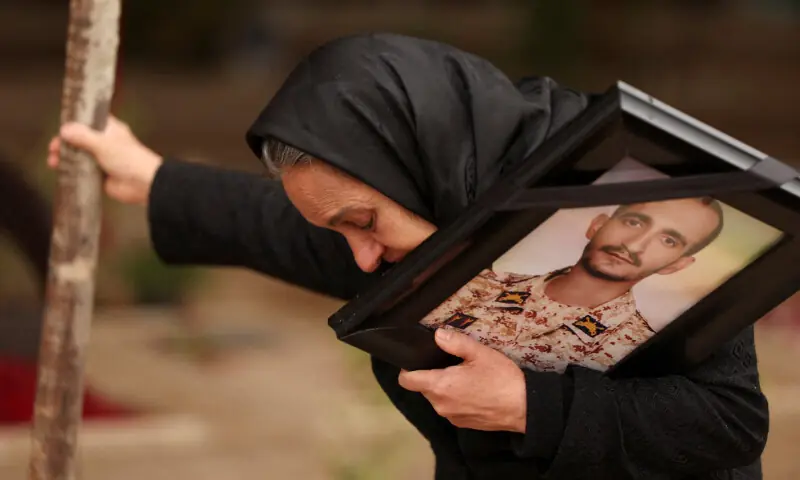
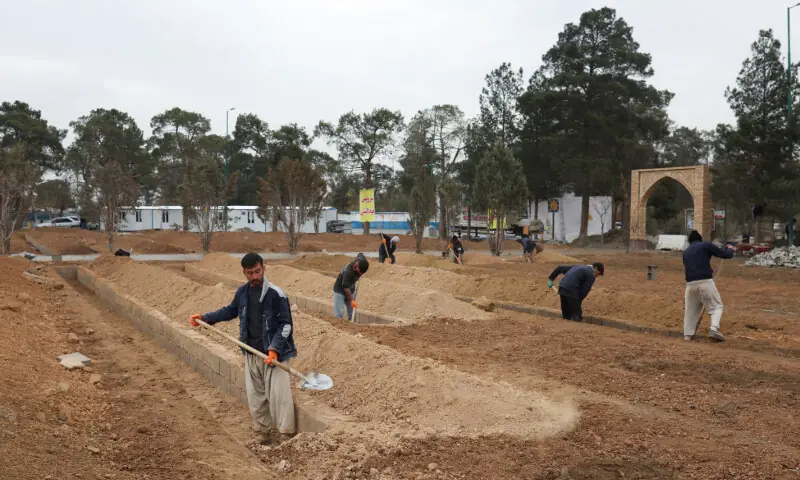
As gravediggers prepared new burial plots for those killed in the US-Israeli attack on Iran, Marzia Razaei wept for her son Arfan Shamei, who died in a blast at a military training camp days before he was due home on leave.
The war that began on February 28 with a blitz of air strikes on Tehran and other cities has killed more than 1,300 Iranians so far, according to Iranian officials, and plunged the Middle East into crisis.
Tears streamed down Razaei’s face and she stared vacantly, hugging a large portrait of Shamei, 23, her voice breaking with grief as she recalled her last conversation with him when they discussed his coming trip back home to his family.
“I hadn’t seen him for two months,” she said, adding that his last day before heading home was meant to have been Monday, the day Reuters met her.
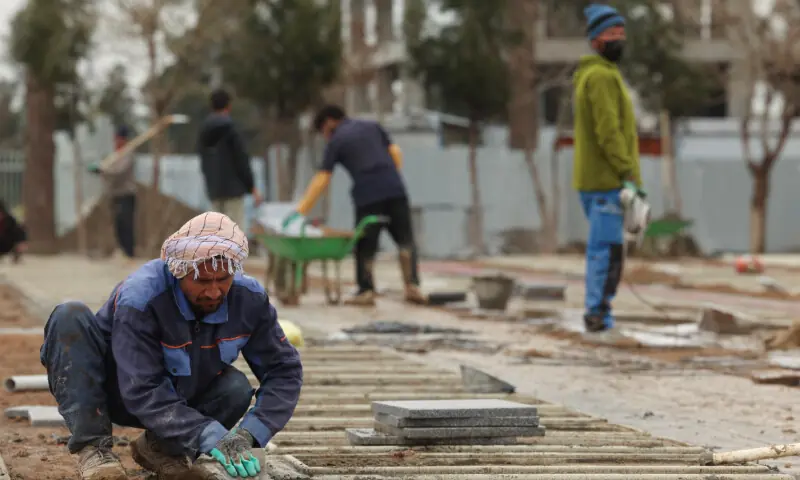
He was to have been married soon afterwards and the trip home was part of the preparations for the wedding.
Shamei was killed in a blast at his training camp in Kermanshah in western Iran on March 4 that turned his tent into a ball of flame and left his body so charred that Razaei was not able to see it.
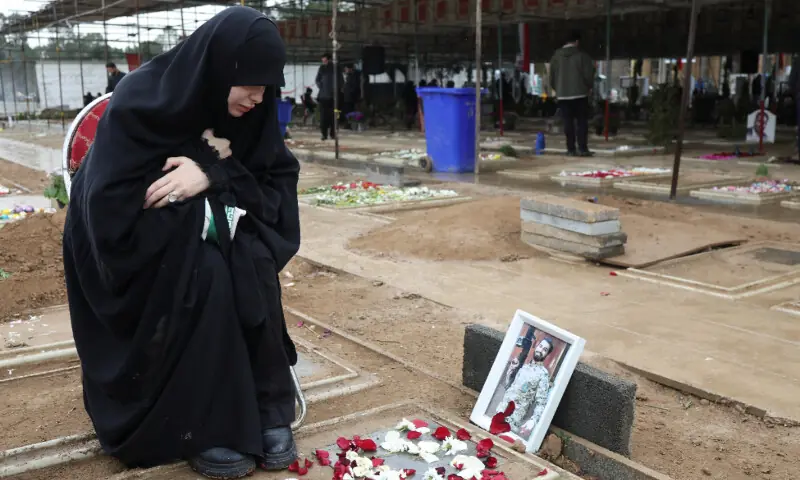
“My son used to be scared of the dark,” she said, sitting in front of his grave in the massive Behesht-e Zahra cemetery that sprawls across a large area just south of Tehran, the rain drizzling steadily around her.
Shamei and others killed in the current conflict are buried in Section 42 of the cemetery, where a dozen gravediggers were busy on Monday preparing for burials while workers readied white marble stones engraved with the names of the deceased.
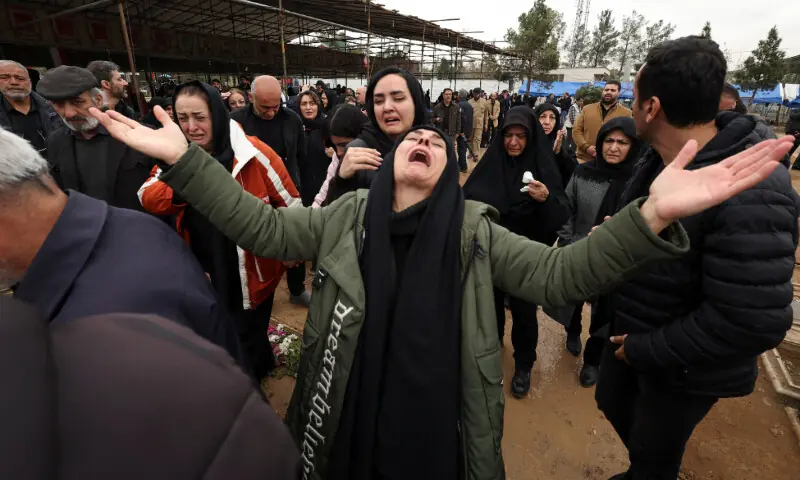
As another body was brought in for burial, the bier carried on the shoulders of family members, the sound of an air strike echoed across the cemetery, grey smoke rising up from a nearby district.
Graves lay under a canopy decorated with pictures of the dead and Iranian flags, as families gathered, crying and talking. Women sat by the graves, some quietly weeping, others so distraught they were beating their chests with their fists.
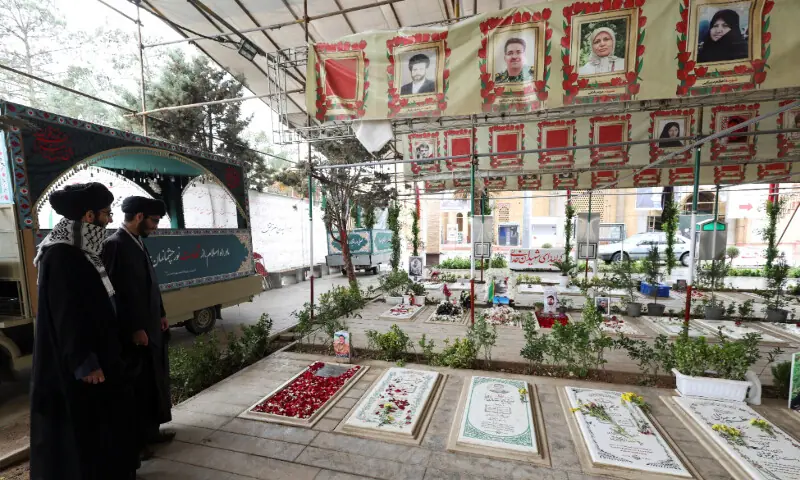
A truck stood nearby, loaded with colourful flowers, and petals had been strewn across the graves as loudspeakers played Shi’ite Muslim hymns of mourning.
Other graves in the section contained members of the Basij, a volunteer militia group affiliated with the Revolutionary Guards, and officials and detainees from Evin Prison, which was targeted in the current war and in strikes in June last year.
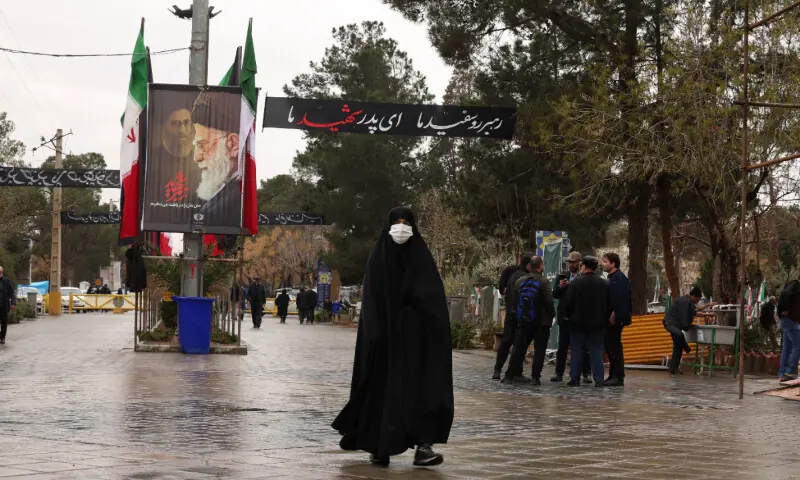
Fatima Darbechi, 58, had lost her 44-year-old brother early in the war as he tried to rescue people trapped in a bombed car when another blast sprayed him with shrapnel, leaving him mortally injured.
Their parents had died when he was a small child. “He grew up without a mother. I raised him,” she said, tears coursing down her cheeks.
For some of the mourners, the sorrow was matched by anger and defiance at Israel and the United States for their bombing campaign.
“When you burn our hearts, you do not stop us, you do not bring us to our knees,” said the mother of 25-year-old Ihsan Jangravi, pumping her fist in the air.
PESHAWAR: The Counter-Terrorism Department (CTD) killed six terrorists during an intelligence-based operation (IBO) in Khyber Pakhtunkhwa’s Lakki Marwat on Friday, according to a press release issued by the CTD.
The press release said the operation was carried out in the Shagai area within the limits of the Gambila police station on the reported presence of terrorists there.
It added that the terrorists opened fire on the CTD team as they approached their location, following which the law enforcers fired in retaliation. The firing continued for around 40 minutes, the press release said, adding that six terrorists were found dead in the ensuing search operation.
The press release said the process of identifying the slain terrorists was under way, following which action would be taken against their facilitators and associates.
Four Kalashnikovs with magazines and ammunition, two 9mm pistols, eight hand grenades and an improvised explosive device was found in the possession of the terrorist, the press release added.
The operation took place the same day when an attack on a police vehicle martyred seven policemen, including an officer, in the Bettani subdivision of Lakki Marwat.
KP has seen a rise in terrorist attacks in the past year. According to the Annual Security Report 2025 from the Centre for Research and Security Studies (CRSS), KP recorded a significant surge in violence last year as “fatalities rose from 1,620 in 2024 to 2,331 in 2025”.
This marked an “absolute increase of 711 deaths, accounting for over 82 per cent of the net national rise and marking almost a 44pc year-on-year surge in violence in the province”.
Last month, nine police personnel, including a deputy superintendent of police (DSP), were martyred in separate terrorist attacks in Punjab’s Bhakkar district and KP’s Kohat and Wana areas.
Only days prior to that, three Federal Constabulary men were martyred in a terrorist attack in Karak, according to officials.
An unidentified shooter was killed on Thursday after exchanging gunfire with security in an attack on a synagogue on the outskirts of Detroit, Michigan, police said.
Police said the gunman was dead following the attack on the Temple Israel synagogue in West Bloomfield.
Law enforcement officers flooded the area soon after the incident, amid heightened tension nationwide over the US-Israeli war on Iran.
“At least one individual came to the temple,” Oakland County Sheriff Michael Bouchard told reporters. “Security saw him, engaged him in gunfire.
“Nobody at the moment has been confirmed to be hurt except potentially the shooter,” Bouchard added. “We’re looking to see if it was more than one person.”
Michigan Governor Gretchen Whitmer condemned the attack on the Temple Israel synagogue.
“This is heartbreaking,” she said. “Michigan’s Jewish community should be able to live and practice their faith in peace. Antisemitism and violence have no place in Michigan,” she said.
The sheriff said law enforcement had been on high alert since the start of the US-Israeli war on Iran nearly two weeks ago.
“We’ve been talking for two weeks about the potential, sadly, of this happening,” Bouchard said. “So there was no lack of preparation. All Jewish facilities in the area are going to have a lot of extra presence around it until we figure this out,” the sheriff said.
Television images showed a massive law enforcement response in the area around the synagogue. Smoke could be seen billowing from what appeared to be a fire in the building.
Local media reported that the assailant had first rammed a car into the synagogue.
The Jewish Federation of Detroit said Jewish agencies were in precautionary lockdown.
“We ask community members to stay away from the area at this time.”
Norwegian police said on Wednesday that three brothers had been arrested on suspicion of a “terrorist bombing” over a weekend explosion at the US embassy in Oslo, which caused minor damage but no injuries.
Police prosecutor Christian Hatlo told a press conference the brothers, who were Norwegian citizens of Iraqi origin, had been arrested in Oslo around 3:30pm local time (2:30pm GMT), and that police were investigating the motive.
“We are still working from several hypotheses. One of them is whether this is an order from a government entity,” Hatlo said.
“This is quite natural given the target — the US embassy — and the security situation the world is in today,” he said.
Hatlo said the investigation would seek to clarify exactly what roles the brothers, who were in their 20s and not previously known to police, had played.
“We believe that one of them is the person who placed the bomb outside the embassy and that the other two were complicit in the act,” Hatlo told reporters.
Hatlo also said that they were not ruling out links to “criminal networks”.
In its annual threat assessment, the Norwegian security service PST said last month that Iran, which it considers one of the main threats to the country, could rely on “proxy actors,” including “criminal networks,” to commit acts.
On Tuesday, Iran’s ambassador in Oslo denied any involvement by his country in the embassy explosion.
“It is unacceptable that we are being singled out,” Alireza Jahangiri told Norwegian newspaper Verdens Gang.
According to police, the perpetrators of the bombing, described as “powerful”, may also have acted out of their own motives.
US embassies have been placed on high alert in the Middle East due to American strikes on Iran. Several have faced attacks as Tehran responds by targeting industrial and diplomatic facilities.
The blast took place at around 1am (12am GMT) on Sunday at the entrance to the embassy’s consular section.
On Monday, two images from surveillance camera footage of a suspect dressed in dark clothing with a hood over his head and wearing a backpack.
Roughly at the time the incident occurred, a video had been uploaded to the Google Maps page for the US embassy.
The video, which has since been taken down, appeared to show Iran’s late supreme leader Ayatollah Ali Khamenei, who was assassinated on the first day of the US-Israeli strikes in Iran.
According to Norwegian public broadcaster NRK, the person who uploaded the video wrote in Persian: “God is great. We are victorious.” Police have also opened an investigation into this.
India fast bowler Arshdeep Singh was fined by the International Cricket Council (ICC) on Tuesday after an incident during the Twenty20 World Cup final when he hurled the ball at New Zealand batsman Daryl Mitchell.
In the 11th over of New Zealand’s chase on Sunday, Mitchell played the ball to Arshdeep and the bowler threw it straight back at him, hitting the New Zealand batter on the pads.
Mitchell was livid and advanced on Arshdeep, who turned around and walked back without apologising, forcing the umpire to step in.
India captain Suryakumar Yadav then came over and apologised.
The ICC said Arshdeep breached the ICC Code of Conduct for “throwing a ball (or any other item of cricket equipment) at or near a player in an inappropriate and/or dangerous manner”, handing him a fine of 15 per cent of his match fee.
Arshdeep, who apologised to Mitchell at the end of the over and again after the match, accepted the sanction.
India beat New Zealand by 96 runs to become the first side to lift the men’s T20 World Cup for a third time.
ISLAMABAD: Aurat March organisers, civil society members, and rights groups accused the authorities on Monday of manhandling and threatening women’s rights activists who had been detained the previous day in Islamabad.
The assertions were made at a press conference after police released all 44 activists detained ahead of an International Women’s Day rally on Sunday.
Police cited the imposition of Section 144 of the Criminal Procedure Code and the district administration not issuing a no-objection certificate (NoC) to the Aurat March for the rally as reasons for the arrests.
After the activists were released, they held a press conference at the National Press Club, demanding an investigation into the incident.
Aurat March’s Dr Farzana Bari said the organisers of the rally were aware that Section 144 was imposed in the federal capital, but “civil society does not accept any law that is in violation of basic rights”.
“You cannot take our right to protest. Similar protests were held across the globe, but we were stopped and told that there was a threat of a suicide bomber blowing themselves up,” she claimed.
Human Rights Commission of Pakistan (HRCP) Secretary General Harris Khalique said: “We don’t believe in violating laws, but with laws such as the Prevention of Electronic Crimes Act (Peca) in place, society cannot function”.
“Yesterday, females were manhandled and beaten,” he alleged, adding that they were detained and taken to Women Police Station.
“When their relatives and friends reached there, they were also locked up. Baton-charge was used against them, they were pulled from their hair, and they were forced to sign on fake affidavits,” he alleged.
Khalique said the HRCP demanded an investigation into the incident and departmental action against those found guilty of the accusations made by him.
PPP Human Rights Cell Information Secretary Tariq Mahmood Ghouri, who is also a part of the Aurat March, claimed while talking to Dawn that the relatives of the detained activists, who went to the police stations, were also detained.
“They were forced to sign an affidavit that said that they (activists) would not participate in such activities in the future. They had to sign it to get their daughters released,” he alleged.
It was also alleged during the press conference that even lawyers were not allowed to meet the detained activists and that male personnel body-searched female detainees.
MIRANSHAH: A child was killed and four people were left injured on Sunday after a mortar shell allegedly fired from the Afghan side landed in a residential area during an exchange of fire near the Pak-Afghan border in North Waziristan, police said.
According to police sources, the incident occurred at around 7:30pm when heavy firing erupted between both sides of the border in the Ghulam Khan area.
During the exchange of fire, a mortar shell fired from across the border fell in the nearby village of Golakhel and exploded in a residential locality, they added.
As a result of the explosion, they said a minor died on the spot while four other people sustained injuries.
Local residents immediately took the injured to the Tehsil Headquarters Hospital in Miranshah, where they were being provided medical treatment.
Hospital sources said some of the injured were in critical condition, while doctors and medical staff remained engaged in emergency treatment.
Following the incident, Tehsildar Miranshah Ghani Wazir and Tehsildar Ghulam Khan Aziz Wazir reached the hospital’s emergency ward on the directives of North Waziristan Deputy Commissioner Yousaf Karim.
They directed doctors and hospital staff to ensure the provision of all necessary medical facilities to the injured.
Officials said the emergency department of the hospital had been put on high alert and treatment of the injured was continuing.
The Ghulam Khan border crossing in North Waziristan is an important route for trade and travel between Pakistan and Afghanistan. However, the crossing remains completely closed at present due to the prevailing security situation.
ISLAMABAD: The Pakistan Institute of Medical Sciences (Pims) said on Tuesday night that PTI founder Imran Khan was examined at Adiala jail for the follow-up treatment of his eye ailment, which showed that his vision had “improved remarkably”.
However, the party asserted that any medical examination carried out without the presence of Imran’s personal physicians and his immediate family lacked “transparency and credibility”.
In a press release, a copy of which is available with Dawn, the Pims administration said that Imran was examined by a medical board comprising Dr Nadeem Qureshi, the head of the vitreoretinal department at Al–Shifa Trust Eye Hospital in Rawalpindi, and Dr M Arif Khan, the head of the ophthalmology department at Pims, Islamabad.
The same team had examined Imran last month in Adiala jail, where the former premier is incarcerated.
“This examination was performed as a follow-up of his second dose of intravitreal injection of anti-VEGF,” the press release said.
According to the American Academy of Opthalmology, an anti-VGEF treatment reduces leaking abnormal blood vessels in the retina. This slows or stops damage from the abnormal blood vessels and slows down vision loss and may also improve vision.
The Pims press release said that during the examination, both of Imran’s eyes were examined for visual acuity, adding that doctors also conducted fundoscopy, slit lamp examination, and optical coherence tomography.
“The board concluded that his vision has improved remarkably, which is substantially good vision at this stage. The board recommended instructions for further care and treatment advice as previously planned,” it said.
Meanwhile, the PTI said it “categorically rejected” the press release issued by Pims.
“Any medical examination conducted without the presence of his personal physicians and his immediate family lacks transparency and credibility,” it said.
The party said that for months, serious concerns had been raised regarding PTI founder’s health, access to independent medical care and the denial of family-supervised evaluations.
“PTI reiterates its clear and non-negotiable demand that Imran Khan must be immediately examined in the presence of his personal physicians and his family members,” it stated.
“As per the wishes of his family, he must be shifted without delay to Shifa International Hospital for independent, transparent and comprehensive medical evaluation and treatment,” it said.
“Nothing short of this will be acceptable,” it added.
“The continued refusal to allow independent medical access only deepens public concern and raises serious questions. The health and well-being of Imran Khan cannot and will not be compromised,” it concluded.
Imran’s eye ailment — right central retinal vein occlusion (CRVO) — came to light in late January. His first medical procedure, which was carried out on January 24, was confirmed by the government five days after reports surfaced about it in the media.
Subsequently, Imran’s lawyer, Salman Safdar, told the Supreme Court that the former premier had lost a significant amount of vision in his right eye while in custody.
A five-member team had initially examined Imran at Adiala jail on Feb 15. On Feb 24, Imran was brought to Pims for a follow-up. According to a Pims doctor, Imran was brought to the hospital for a second dose of anti-VEGF intravitreal injection.
The government and the opposition have been engaged in a blame game, with the latter accusing the former of a lack of transparency on the matter, of not ensuring appropriate treatment for Imran, and of not allowing his personal physicians access to him. The government denies these allegations.
It should also be mentioned that 14 former international cricket captains, including Indian cricket greats Sunil Gavaskar and Kapil Dev, last month demanded better prison treatment for Imran, “one of the finest all-rounders” of the game.
The United Arab Emirates (UAE) has ordered its stock markets closed on Monday and Tuesday as the country reels from Iran’s retaliatory missile and drone strikes, in a sign of the growing economic disruption sweeping the Gulf.
Iran carried out the strikes in Gulf countries that have US bases and assets after joint attacks on the Islamic republic by Israel and America.
The UAE Capital Markets Authority said the Abu Dhabi Securities Exchange and Dubai Financial Market would remain shut on March 2 and March 3, citing its supervisory and regulatory role over the country’s capital markets.
“The Authority will continue to monitor developments in the region and assess the situation on an ongoing basis, taking any further measures as necessary,” it said in a statement.
The UAE’s two exchanges are home to some of the region’s most valuable listed companies.
The closure keeps billions of dollars in listed assets in suspension as investors await clarity on the scale of damage from Saturday and Sunday’s strikes, which hit airports, ports and residential areas across the UAE and broader Gulf region.
Gulf markets that did open on Sunday saw sharp declines. Saudi Arabia’s benchmark index fell more than four per cent at the open, Oman dropped 3pc and Egypt’s main index shed 5.44pc, while Kuwait suspended trading entirely.
All parties were advised to follow official UAE Capital Markets Authority, ADX and DFM channels for updates on the resumption of trading.
If the war between Iran and the United States escalates, the single biggest economic threat to Pakistan will come from oil.
Brent crude settled around $72.5 a barrel on Friday, already up nearly 19 per cent year-to-date, according to CNBC. Rumours are swirling of oil touching $100.
For Pakistan, even modest increases carry heavy consequences.
For every $10 rise in oil prices, the current account deficit increases by roughly $1.5–$2 billion, explains former chief executive officer of the Pakistan Business Council, Ehsan Malik.
“If prices were to climb to $100, the deficit could expand by $5–$7bn on an annualised basis, potentially undoing recent gains that allowed FY25 to post a $2bn current account surplus.”
Markets are extremely erratic right now, says energy analyst Syed Rashid Husain.
Iran produces roughly 3–3.5 million barrels of oil per day, exporting about 1–1.5m barrels. While this is far lower than the output of the United States (about 13.5m barrels per day) or Saudi Arabia (around 9–10m), even a loss of one million barrels per day can tighten global balances and push prices higher.
Compounding the risk is the strategic importance of the Strait of Hormuz, the narrow waterway through which roughly 20pc of global oil consumption passes. For years, Iran has threatened to block this passage during periods of heightened conflict.
According to Reuters, oil and gas shipments through the area have already faced disruption, with Iran’s Revolutionary Guards reportedly warning ships that passage is not permitted, although Tehran has not formally confirmed such an order.
Analysts say scenarios range from limited disruptions to Iranian exports to a full blockade of Hormuz.
The ripple effects are already visible. Late Saturday night, petrol prices at pumps in Canada had risen by roughly 10–15 cents per litre, Husain said, speaking from experience.
For Pakistan, the situation evokes the economic horror of the Russia–Ukraine war. During 2022-23, Brent crude hovered around $100–125 per barrel, leading Pakistan to float perilously close to sovereign default.
The chain reaction was brutal. The war pushed up oil prices, widening Pakistan’s import bill and putting pressure on the exchange rate. The rupee slid from around Rs170 per dollar in early 2022 to a peak of Rs305 on Aug 28, 2023, before stabilising in the Rs270–280 range toward the end of that year.
There was, however, an important cushion at the time. Despite sanctions, Russia still exported oil and gas by hook or by crook to many countries; Pakistan also tried to get oil from Russia, and India became a major importer of Russian oil.
Since then, however, the US has pressured India to stop importing and tightened the screws on all of Russia’s supplies. If Iranian barrels are disrupted simultaneously, two significant discounted supply streams could disappear, pushing crude firmly into triple-digit territory if tensions do not de-escalate.
There are already signs of strain. Saudi Aramco has reportedly not allocated a March cargo to a Pakistani refinery amid volatility in global oil markets. Uncertainty in global crude trade has made it difficult to secure shipments for March, and this was before the news of the assassination of Iran’s Supreme Leader Ayatollah Khamenei.
Marine insurers are also considering repricing or cancelling policies in parts of the Middle East, according to reports.
Oil prices have a multiplier effect as they impact secondary markets.
For example, edible oil prices — of which Pakistan imported roughly $3.7bn in FY25 — are indirectly linked to crude oil markets, Malik explains.
Much of the economic breathing space that enabled recent stabilisation came from relatively stable global commodity prices.
“For every $10 increase in oil prices, Pakistan’s inflation typically rises by about 0.5–0.6 percentage points,” says Waqas Ghani, Head of Equity Research at JS Global Capital.
If oil prices surge, inflation would rise again, making further policy rate cuts unlikely.
Industry would face higher input costs, weakening exports. At the same time, fiscal space would shrink, limiting the government’s ability to lower taxes or provide relief, adds Malik.
“The veneer of stability has been damaged,” says Ammar H Khan, Professor of Practice at the Institute of Business Administration Karachi. Capital outflows could increase, or new investment could slow, hurting job creation and — at the margins — reducing demand for migrant labour abroad.
These repercussions may also extend to remittances, which are vital for keeping the current account afloat.
Even if the conflict lasts only a few days and does not turn into a prolonged war, heightened regional risk can weigh on financial flows, he adds.
All this is taking place in the background of talks with the visiting International Monetary Fund (IMF) team. Industry sources say there had been positive talks with the Fund regarding possible tax relief in the upcoming budget. Prime Minister Shehbaz Sharif also emphasised the need to reduce direct tax rates.
However, given the current global uncertainty, meaningful relief now appears unlikely.
Pakistan was already receiving very little foreign direct investment, notes M Abdul Aleem, secretary general of the Overseas Investors Chamber of Commerce and Industry.
“What little was in the pipelines, like investments in Reko Diq, will slow down for now,” he says.
“Equally concerning is the law-and-order environment, particularly when it involves the safety of foreign nationals.”
Referring to the recent incident at the US consulate in Karachi, he said stronger preventive security measures should have been in place.
For equity markets, the implications extend beyond macroeconomic concerns.
Pakistan’s manufacturing sectors rely heavily on imported raw materials and energy inputs. “Take the cement sector as an example,” says Waqas Ghani, Head of Equity Research. “It relies on coal and petcoke as key inputs. If oil prices rise, the prices of these fuels also increase, raising production costs.”
Because many industries depend on imported inputs across the value chain, higher commodity prices quickly squeeze profit margins.
“When input costs rise, margins come under pressure, and corporate earnings can deteriorate,” he said. “Apart from oil and exploration companies, most sectors would face headwinds.”
Beyond fundamentals, market sentiment itself has turned cautious.
“Investors are already becoming more risk-averse,” Ghani noted. “When uncertainty rises, equities are usually the first asset class where investors reduce exposure.”
Several technical factors are also amplifying selling pressure. Foreign investors have been net sellers in recent weeks, while mutual funds are facing redemption pressures from retail investors. When investors withdraw money, fund managers are forced to liquidate holdings, increasing supply in the market.
“At the same time, settlement dynamics can intensify the pressure,” Ghani added. The Pakistan Stock Exchange currently operates on a T+1 settlement cycle, while the banking system operates on a T+2 cycle, which can create short-term liquidity stress for brokers and investors during periods of volatility.
“All these factors combined can create a downward spiral where selling feeds on itself,” he said.
For now, the key trigger that could stabilise markets would be a de-escalation of geopolitical tensions.
“If the conflict subsides and oil prices stabilise, sentiment could recover fairly quickly,” Ghani said. “But until then, markets are likely to remain under stress.”
Much, however, will depend on how global markets react when trading begins.
“It all depends on the evolving situation and any ceasefire news,” said Muhammad Sohail, CEO of Topline Securities. “A lot will hinge on how US futures open, along with the trend in oil prices and Asian markets.”
Pakistani stocks are likely to fall initially, he added, though the extent will depend on developments overnight. Some markets that opened on Sunday were already down close to two per cent.
Ali Nawaz, CEO of Chase Securities, expects early weakness in trading when it begins.
“The market is likely to see a decline in the opening hours, driven by investor concerns over the US-Iran conflict, the broader Middle East situation and rising oil prices,” he said.
However, he expects the pressure to ease as the week progresses.
“A recovery could follow as the situation moves towards resolution and institutional investors step in for value buying,” Nawaz said. Given the market’s recent corrections, further declines may create attractive valuations for investors, echoing the age-old advice to buy the dip.
As the Pakistan Stock Market bleeds, investors may turn to gold, which is expected to surge. On Saturday, local gold prices jumped by Rs10,000 per tola in Pakistan. Qasim Shikarpuri, president of the All Pakistan Sarafa Gems and Jewellers Association, expects international prices to rise by $200–$300 per ounce once markets reopen.
“If that happens, local gold prices could surge by as much as Rs60,000 per tola,” he said.
Retailers say geopolitical tensions are already affecting shopping activity during Ramazan, a critical sales period for bazaars and malls.
“We have seen this before,” said Asfandyar Farrukh, Chairman of the Chainstore Association of Pakistan. “Even a few days ago, when tensions flared between Pakistan and Afghanistan, and warnings were issued, there was an immediate impact.”
The effect is most visible over the weekend, when shopping activity typically peaks.
“Weekend footfall is usually the highest, especially on Sundays. But in such situations, visitor numbers can fall by half,” he said.
If the tensions subside quickly, retailers expect the slowdown to be temporary.
“If things improve within two or three days, the lost sales can be made up,” he said. “But if uncertainty continues through Ramazan, then the impact could become more significant.”
According to Farrukh, shoppers tend to adjust their behaviour during prolonged uncertainty rather than abandoning shopping altogether.
“People still need to shop for Eid. What they usually do is go out earlier in the day or spread their visits over time,” he said. “But overall, there could still be a 20–25pc decline in footfall during periods of heightened tension.”
Retail activity during Ramazan typically peaks in the final ten days before Eid, though momentum had only recently begun building in markets.
“The last ten days are usually when Ramazan shopping really accelerates,” he said. “But we are already beginning to see some slowdown.”
Farrukh does not expect security concerns to push shoppers significantly toward online retail.
“Eid shopping is an experience. People want to see the fabric, the material, the footwear, hence they prefer to visit markets,” he said. “Online shopping has been growing, but it does not replace the Eid shopping experience.”
Instead, the larger risk for retail spending comes from rising fuel prices.
“If oil prices surge, that will have the biggest impact on consumer spending,” he said. “Fuel prices have already increased, and further hikes are expected. If this situation continues for several days, it would directly affect household spending.”
Ultimately, much will depend on whether the conflict escalates or finds an off-ramp.
“Domestic politics in the United States may ultimately shape how far this confrontation goes. The US faces congressional midterm elections in November 2026,” notes Husain.
With the American economy already grappling with tariff shocks and a cooling job market amid massive AI investments, the cost of living remains a top voter concern. Surveys cited by The Wall Street Journal show that inflation and household costs remain the most persistent economic complaints.
If gas prices surge sharply, it could damage Republicans at the ballot box, potentially costing them control of the House or the Senate and undermining the administration’s ability to pass major legislation.
That may explain why Donald Trump has suggested there are several “off-ramps” from the military operation, in recent comments to media outlet Axios. Trump is also facing pressure from how own Make America Great Again (MAGA) political base to avoid a prolonged Middle East intervention.
Equally important is Iran’s reaction.
“Iranians have historically been pragmatic in such circumstances,” Husain said. After the killing of Iranian commander Qasem Soleimani in 2020 and the assassination of Hamas leader Ismail Haniyeh in 2024, Tehran’s responses were calibrated.
“There will almost certainly be face-saving measures,” Husain said. “But if past behaviour is any guide, those may eventually be accompanied by efforts to de-escalate as well.”
Pakistan has paid a heavy price on its path to stabilisation. Its fragile economic recovery relies heavily on stable oil prices. The difference between escalation and restraint could mean the difference between continued stabilisation and another severe macroeconomic shock.
Header image: In this file photo, pumpjacks are seen against the setting sun at the Daqing oil field in Heilongjiang province, China, on December 7, 2018. — Reuters
