Israeli airstrike hits building in Gaza City
from NBC News Top Stories https://ift.tt/PU3i46j
from NBC News Top Stories https://ift.tt/PU3i46j

The government on Saturday hiked the rate for high-speed diesel (HSD) by Rs11.30, while leaving the price of petrol unchanged for the coming fortnight.
In a late-night notification, the Petroleum Division said the revision followed movements in international markets and recommendations from the Oil and Gas Regulatory Authority (Ogra).
According to the notification, the ex-depot price of HSD was set at Rs268.38 per litre from Rs257.08 per litre.
Most of the transport sector runs on HSD. Its price is considered inflationary as it is mostly used in heavy transport vehicles, trains and agricultural engines like trucks, buses, tractors, tube-wells, threshers, and particularly adds to the prices of vegetables and other eatables.
Meanwhile, the ex-depot petrol price was unchanged, remaining Rs253.17 per litre.
Petrol is primarily used in private transport, small vehicles, rickshaws, and two-wheelers, and directly impacts the budgets of the middle and lower-middle classes.
The notification said the prices would be applicable from February 1 (Sunday).
At least two federal agents who were involved in Saturday’s fatal shooting of a US citizen in Minneapolis have been placed on administrative leave, two US media outlets said on Wednesday.
The Department of Homeland Security (DHS) said the two immigration agents who discharged their weapons during the deadly encounter with Alex Pretti were put on leave as part of standard procedures, Fox News reported.
MS NOW earlier reported that agents involved in the shooting of Pretti were being put on leave, citing an unnamed source.
Representatives for DHS could not be immediately reached to confirm the reports.
Immigration agents on Saturday fired multiple shots at Pretti, an ICU nurse at a hospital for veterans.
His death was the second fatal encounter between Immigration and Customs Enforcement agents and US citizens in Minnesota this month, sparking a national uproar.
Meanwhile, an initial US government review of the fatal shooting of Pretti made no mention of him brandishing a firearm, despite initial statements by Trump officials highlighting the weapon.
A preliminary review by US Customs and Border Protection (CBP) said Pretti, 37, was shot by two federal officers, a Border Patrol agent and a customs officer, after he refused to move out of the street following an order from a customs officer.
The DHS said he “approached US Border Patrol officers with a 9 mm semi-automatic handgun, but did not mention that the weapon was holstered.
The CBP review, conducted by the agency’s Office of Professional Responsibility and shared with lawmakers on Tuesday, is standard protocol and shared with members of Congress to promote transparency, CBP spokesperson Hilton Beckham said.
Beckham said the notifications “provide an initial outline of an event that took place and do not convey any definitive conclusion or investigative findings”.
Details in the preliminary review reinforced the disconnect between how Trump officials portrayed the shooting and the video evidence.
The review said that a customs officer tried to move Pretti and a woman out of the street, but that they “did not move”.
The officer then fired pepper spray at Pretti and the woman, it said.
CBP customs officers normally work at ports of entry, screening passengers and goods entering the US, but some have been detailed to work on immigration enforcement by the Trump administration as part of its crackdown.
The identities of the agents and officers at the scene and whether they had any experience with crowd control in urban environments have not been made public.
The CBP internal assessment said that the agency’s personnel tried to take Pretti into custody and that “a struggle ensued”.
A Border Patrol agent shouted “He’s got a gun!” multiple times during the struggle, the review said. Five seconds later, a Border Patrol agent and a customs officer fired at Pretti.
Video showed an agent removing Pretti’s gun from his waist prior to the shooting. The review was based on footage from body-worn cameras and CBP documentation, it said.
Indonesian authorities resumed search-and-rescue efforts for 80 people missing after a landslide killed 10 in a residential area of West Java province.
The landslide early on Saturday was triggered by heavy rains starting the day before, which the weather agency warned could continue for a week in the province and several other regions.
Resident Dedi Kurniawan, 36, said it was the first big landslide he had witnessed in Pasir Langu village in a hilly area of the province about 100 km (60 miles) southeast of Indonesia’s capital, Jakarta.
“Sometimes we have only small floods from the nearest river, but this time (the landslide) came from the forest,” he told Reuters.
Rescuers were hampered on Saturday as unstable terrain and rain hindered them from deploying heavy machinery, Kompas TV reported, citing authorities.
There were multiple reports of floods in West Java, including Jakarta. The floods have caused residents in heavily impacted areas to evacuate to higher ground or unaffected places.
The landslide occurred two months after cyclone-induced floods and landslides on the island of Sumatra killed 1,200 people, destroyed homes and displaced over a million residents.
US President Donald Trump announced on Thursday that he will sue The New York Times over an unfavourable opinion poll and suggested that what he called “fake” surveys should be criminalised.
Trump lashed out after publication of a New York Times/Siena University poll finding only 40 per cent approval for the 79-year-old Republican — in line with multiple other polls showing declining support a year into his second term.
“The Times Siena Poll will be added to my lawsuit against The Failing New York Times,” Trump said on his Truth Social platform. “They will be held fully responsible for all of their Radical Left lies and wrongdoing!”
Expanding on the threat, Trump posted that “Fake and Fraudulent Polling should be, virtually, a criminal offence”.
Trump has fired off multiple defamation lawsuits against media companies, including the BBC, CNN, Wall Street Journal, CBS and ABC. Some have ended in multi-million-dollar settlements.
He first filed a $15 billion defamation suit against the Times in September 2025, claiming the leading US newspaper had run false stories to hurt his 2024 presidential campaign and reputation.
The complaint was thrown out by a federal judge before being refiled in amended form in October.
The Times responded by calling that new lawsuit “an attempt to stifle independent reporting” and “intimidation”.
Thursday’s Times/Siena poll was the latest opinion survey finding that Trump’s popularity continues to slide over his handling of the economy and a military-style crackdown on illegal immigration.
Times/Siena is considered to be among the most accurate and highest profile of US political surveys.
Its latest findings were especially notable for laying out what the Times called the unravelling of Trump’s winning 2024 coalition.
Young and non-white voters who turned out for Trump in the election against Democrat Kamala Harris have now left him, the poll found, leaving him with his previous core base of older and white voters.
A large fire erupted at the Gul Plaza shopping mall on Karachi’s MA Jinnah Road on Saturday night, killing at least three people, according to officials.
Dr Sabir Memon, executive director of the Civil Hospital trauma centre, said three dead bodies had been brought to the facility. He said that all three were dead when they were brought to the hospital.
South Deputy Inspector General Syed Asad Raza told Dawn that seven others were injured.
Rescue 1122 spokesperson Hassaanul Haseeb Khan told Dawn that the fire erupted in shops located on the ground floor. However, he said there were people stuck on the upper portion of the high-rise building.
“Six people have been injured and taken to the hospital,” he said. “Six fire tenders are busy controlling the fire; however, the situation is critical,” he said.
Garden Sub-divisional Police Officer (SDPO) Mohsin Raza said in a statement that the fire appeared to have been caused by a short circuit at one of the shops, before spreading to the entire mall.
He said that seven fire brigade vehicles were busy extinguishing the flames. He said that authorities at Civil Hospital had also been alerted.
Sindh Home Minister Ziaul Hassan Lanjar directed officials to divert traffic in the area to alternative routes for the safe passage of citizens.
In a statement, he said that the cause of the fire should be ascertained through a thorough investigation. He said that the building should be secured so that the fire did not spread.
The minister said the routes should be cleared so that fire brigade vehicles could access the scene.
The development comes a day after at least 20 containers, mostly containing electrical batteries, were destroyed as a huge fire erupted at the Karachi Port Trust (KPT) on Friday afternoon.
US President Donald Trump said Friday he may impose trade tariffs on countries that don’t support his plans to take over Greenland, part of the territory of Denmark.
“I may put a tariff on countries if they don’t go along with Greenland, because we need Greenland for national security,” Trump said at a health roundtable at the White House. “I may do that,” added Trump.
Trump compared the possible Greenland tariffs to those that he threatened on France and Germany last year over the price of pharmaceutical products.
The threat is the latest pressure tactic by Republican Trump as he steps up his bid to acquire the autonomous Arctic island, a goal that he has threatened to achieve by military means if necessary.
Trump claims the United States needs mineral-rich Greenland and has accused Greenland of not doing enough to ensure its security against rivals Russia and China.
European nations have in recent days shown their support for North Atlantic Treaty Organisation (Nato) ally Denmark and Greenland over Trump’s escalating threats, including by sending troops to the strategic territory.
The foreign ministers of Denmark and Greenland visited the White House on Wednesday for talks to defuse the issue, but said afterwards that they remained in “fundamental disagreement” with Trump.
But the United States, Denmark and Greenland had agreed to set up a working group to continue talks every two to three weeks on the issue, the White House said on Thursday.
A bipartisan US Congress delegation began a visit to Copenhagen on Friday to voice support for Denmark and Greenland after Trump threatened to take over the Arctic island, an autonomous Danish territory.
The two-day visit comes alongside a European show of support in the form of a military reconnaissance mission to Greenland.
The 11 congressmen and women were to hold talks with Danish Prime Minister Mette Frederiksen and her Greenlandic counterpart Jens-Frederik Nielsen.
The group arrived at the Danish employers’ association Dansk Industri around midday for discussions with business leaders.
They were due later to meet members of the Danish parliament, over which the Greenlandic flag was raised on Friday in a show of unity.
“We are showing bipartisan solidarity with the people of this country and with Greenland. They’ve been our friends and allies for decades,” Democratic Senator Dick Durbin told reporters.
“We want them to know we appreciate that very much. And the statements being made by the president do not reflect what the American people feel,” he added of Trump.
An AFP reporter in Copenhagen saw a large black van leave Frederiksen’s office shortly before noon on Friday, but her office declined to confirm whether the meeting had taken place.
The delegation’s visit follows a meeting in Washington on Wednesday at which Danish representatives said Copenhagen and Washington were in “fundamental disagreement” over the future of Greenland.
In Greenland’s capital, Nuuk, residents welcomed the show of support.
“(US) Congress would never approve of a military action in Greenland. It’s just one idiot speaking,” a 39-year-old union representative told AFP.
“If he does it, he’ll get impeached or kicked out. If people in Congress want to save their own democracy, they have to step up,” said the union rep, speaking on condition of anonymity.
Trump claims the United States needs mineral-rich Greenland and has criticised Denmark for, he says, not doing enough to ensure its security.
The US president has pursued that argument, despite strategically located Greenland — as part of Denmark — being covered by NATO’s security umbrella.
Military personnel were more visible in Nuuk on Friday, according to an AFP journalist, days after Denmark said it was beefing up its defence on the island.
“I don’t think troops in Europe impact the president’s decision-making process, nor does it impact his goal of the acquisition of Greenland at all,” White House press secretary Karoline Leavitt told a briefing.
Danish Foreign Minister Lars Lokke Rasmussen retorted that a US acquisition of Greenland was “out of the question”.
The European troop deployment in Greenland for a military exercise is aimed at “sending a signal” to “everyone”, including the United States, that European countries are determined to “defend (their) sovereignty”, French armed forces minister Alice Rufo said.
Britain, Finland, France, Germany, the Netherlands, Norway and Sweden have announced the deployment of small numbers of military personnel to prepare for future exercises in the Arctic.
“A first team of French service members is already on site and will be reinforced in the coming days with land, air and maritime assets,” French President Emmanuel Macron said on Thursday.
Large demonstrations are planned across Denmark and Greenland on Saturday to protest against Trump’s territorial ambitions.
Thousands of people have taken to social networks to say they intend to take part in the protests organised by Greenlandic associations in Nuuk and Copenhagen, Aarhus, Aalborg and Odense.
In addition to Durbin, the US delegation included Democratic senators Chris Coons, Jeanne Shaheen and Peter Welch, as well as Republicans Lisa Murkowski and Thom Tillis.
Democrats from the House of Representatives in the delegation are Madeleine Dean, Steny Hoyer, Sara Jacobs, Sarah McBride and Gregory Meeks.
WASHINGTON: The Walt Disney Company has announced the creation of a new enterprise-wide marketing and brand organisation and named Pakistan-born executive Asad Ayaz as its first chief marketing and brand officer, a role that will place him among the most senior leaders at the global entertainment giant.
Ayaz, who was born in Pakistan in 1978, is the son of a senior officer of the Pakistan Air Force. He spent part of his childhood in the Middle East when his father served as Pakistan’s ambassador to Syria and Lebanon, before immigrating with his family to the United States as a teenager.
Disney said the new organisation is aimed at aligning marketing teams across its businesses more closely and strengthening how the company connects with consumers worldwide.
In his new role, Ayaz will lead marketing and brand strategy across Disney’s studios, streaming platforms, theme parks and consumer products.
Announcing the appointment, Disney Chief Executive Officer Bob Iger said the new role was critical at a time when the company’s businesses and consumer touchpoints had expanded rapidly.
“Over more than two decades at the company — and as Disney’s first-ever chief brand officer — Asad has helped bring the magic of Disney to life for millions through his exceptional leadership,” Iger said.
“As our businesses have evolved, it’s clear that we need a company-wide role that ensures brand consistency and allows consumers to seamlessly interact with our products and experiences.”
Ayaz joined Disney more than 20 years ago and most recently served as president of marketing for The Walt Disney Studios, while also leading global marketing for Disney+. He was appointed chief brand officer in 2023, overseeing company-wide brand strategy, partnerships and major events.
In interviews, Ayaz has spoken about his early fascination with popular culture after moving to the United States. He told the advertising-industry group World Federation of Advertisers in 2024 that his teenage bedroom walls featured posters of Batman Returns, The Simpsons and Thelma & Louise.
After graduating from Bennington College in Vermont, Ayaz worked in consulting before moving to Los Angeles to pursue a master’s degree in economics at the University of Southern California, where he gained his first exposure to the entertainment industry.
Disney’s senior leadership, including Disney Entertainment Co-Chairs Alan Bergman and Dana Walden, Disney Experiences Chairman Josh D’Amaro and ESPN Chairman Jimmy Pitaro, described Ayaz as “an exceptional creative leader with strong strategic and operational prowess”.
As the chief marketing and brand officer, Ayaz will report directly to Iger, while also working with the heads of Disney’s business segments.
The company said the unified marketing structure would improve agility, strengthen brand consistency and enhance how Disney engages audiences globally.
Ayaz’s appointment adds him to a small but growing list of senior executives of Pakistani origin holding top leadership positions at major US corporations.
Tech giants Apple and Google on Monday announced a multi-year partnership that will see Apple’s next-generation artificial intelligence (AI) features, including its Siri assistant, be powered by Google’s Gemini technology.
The collaboration marks a significant shift for Apple, which has traditionally developed its core technologies in-house.
A joint statement said Apple selected Google’s AI technology after a “careful evaluation” determined it provided “the most capable foundation” for the iPhone-maker’s AI ambitions.
The announcement represents a rare alliance between two companies that have long competed in the smartphone market, where Apple’s iOS and Google’s Android operating systems dominate globally.
However, the two rivals have maintained a lucrative partnership for years, with Google paying Apple billions of dollars annually to remain the default search engine on iPhones and other Apple devices.
That arrangement has faced scrutiny from regulators, with the US Justice Department arguing in an antitrust case that the deal helps Google maintain its search monopoly, though a judge said the arrangement could continue.
Financial details of the AI arrangement were not provided.
Dan Ives of Wedbush Securities said the partnership was “a major validation moment for Google” and “a stepping stone” for Apple to get its AI strategy on track into 2026 and beyond.
Apple reportedly also considered partnerships with OpenAI, Anthropic, and Perplexity.
The company co-founded by Steve Jobs is largely perceived to have stumbled in efforts to roll out AI capabilities across its products and last month announced the head of its artificial intelligence team was stepping down.
Apple last year delayed the release of an improved Siri digital assistant and is now promising it for later in the year.
Google, Microsoft, OpenAI and other tech rivals have been releasing ever-improved AI models and features in a fierce race to lead the sector.
Despite the collaboration, Apple emphasised that its in-house AI system, Apple Intelligence, will be used to power its iPhones and iPads at the device-only level, maintaining what it described as “industry-leading privacy standards“.
The US Department of Homeland Security is sending “hundreds” more officers to Minnesota, a day after tens of thousands of people marched through Minneapolis to protest the fatal shooting of a woman by an immigration agent, Homeland Security Secretary Kristi Noem said in remarks that aired on Sunday.
The officers would be deployed on Sunday and Monday to bolster the safety of Immigration and Customs Enforcement and Border Patrol officials already in Minnesota, Noem said on Fox News’ “Sunday Morning Futures” programme.
Some 2,000 federal officers have already been dispatched to the Minneapolis-St. Paul area in what DHS has called its largest operation ever.
The new deployments were scheduled to begin even as more than 1,000 rallies were planned nationwide this weekend to protest the federal government’s deportation push and Wednesday’s fatal shooting of 37-year-old Renee Good by an ICE officer.
Minnesota officials have called the shooting unjustified, pointing to bystander video they say showed Good’s vehicle turning away from the agent as he fired.
Noem and other US officials have maintained that the agent acted in self-defence because Good, a volunteer in a community network that monitors and records ICE operations in Minneapolis, drove forward in the direction of the agent who then shot her, after another agent had approached the driver’s side and told her to get out of the car.
In a separate Sunday appearance on CNN’s “State of the Union,” Noem said other video footage showed Good protesting ICE agents at other locations earlier on Wednesday morning, but did not say if or when it would be publicly released.
Minnesota authorities on Friday said they were opening their own criminal investigation into the incident, after some state law enforcement officials said the FBI was refusing to cooperate with state investigators.
White House Border Security Czar Tom Homan said on “Fox News Sunday” that he wanted to let the investigation play out, but that he “truly believe that officer thought his life was in danger to take that action.”
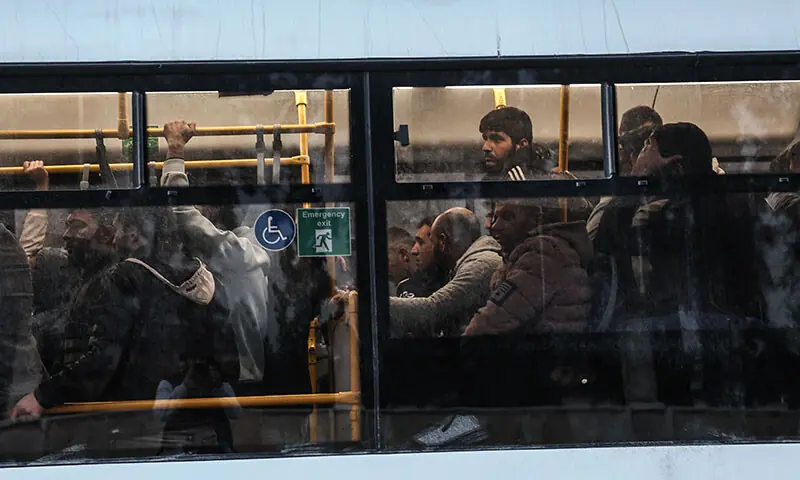
Syrian authorities on Saturday began transferring Kurdish fighters from the country’s second city, Aleppo, to areas they control in the country’s northeast, state television reported, after days of deadly clashes.
The violence in Aleppo erupted after efforts to integrate the Kurds’ de facto autonomous administration and military into the country’s new government stalled.
Since the fighting began on Tuesday, at least 21 civilians have been killed, according to figures from both sides, while Aleppo’s governor said 155,000 people have been displaced.
On Saturday evening, state television reported that Kurdish fighters “who announced their surrender … were transported by bus to the city of Tabaqa” in the Kurdish-controlled northeast.
An AFP correspondent saw at least five buses on Saturday carrying fighters leaving the Kurdish-majority Sheikh Maqsud district, accompanied by security forces.
Their departure came as US envoy Tom Barrack on Saturday met with Syrian President Ahmed al-Sharaa, and afterwards issued a call for a “return to dialogue” with the Kurds in accordance with an integration agreement sealed last year.
In a statement to the official SANA news agency earlier today, the military announced “a halt to all military operations in the Sheikh Maqsud neighbourhood”.
A Syrian security source had told AFP that the last Kurdish fighters had entrenched themselves in the area of al-Razi hospital in Sheikh Maqsud, before being evacuated by authorities.
On the outskirts of Sheikh Maqsud, families who were unable to flee the violence were leaving, accompanied by Syrian security forces, according to an AFP correspondent.
Men were carrying their children on their backs as women and children wept, before entering buses taking them to shelters.
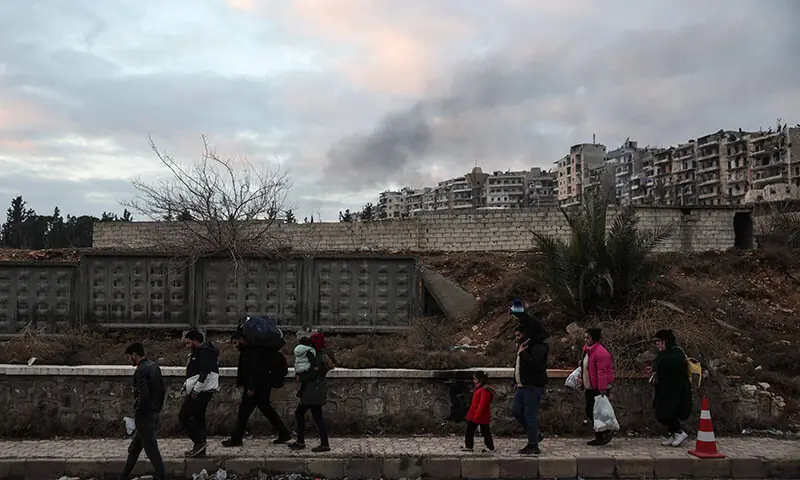
Dozens of young men in civilian clothing were separated from the rest, with security forcing them to sit on the ground, heads down, before being taken by bus to an unknown destination, according to the correspondent.
Government forces began striking the district overnight after a deadline elapsed for Kurdish fighters to withdraw during a ceasefire.
At the entrance to the district, 60-year-old resident Imad al-Ahmad waited for permission from the security forces to return home.
“I left four days ago… I took refuge at my sister’s house,” he told AFP. “I don’t know if we’ll be able to return today.”
Nahed Mohammad Qassab, a 40-year-old widow also waiting to return, said she left before the fighting to attend a funeral.
“My three children are still inside, at my neighbour’s house. I want to get them out,” she said.
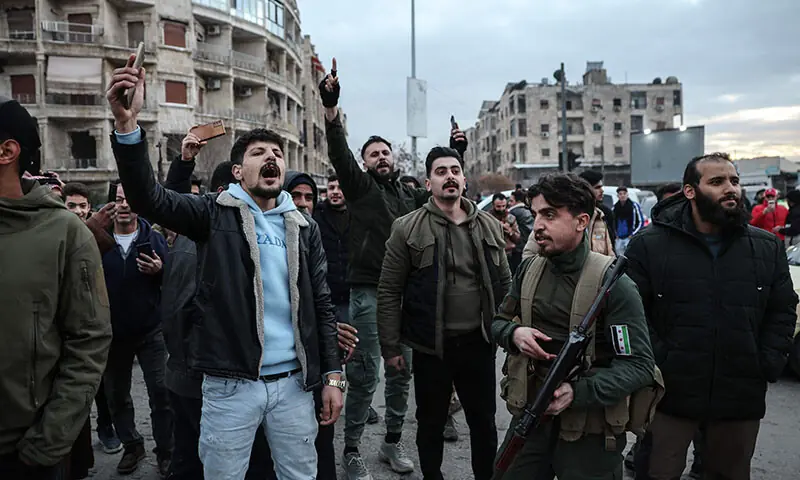
The clashes, some of the most intense since Syria’s new authorities took power, present yet another challenge as the country struggles to forge a new path after the ousting of longtime ruler Bashar al-Assad in December 2024.
Both sides have blamed the other for starting the violence in Aleppo.
Kurdish forces earlier reported coming under artillery and drone attacks, and claimed on social media to be mounting a “fierce and ongoing resistance”.
The army said three soldiers had been killed by Kurdish fighters, while state television accused them of launching drones at residential areas of Aleppo. A flight suspension at Aleppo airport was extended until late Saturday.
The Kurdish-led Syrian Democratic Forces (SDF) control swathes of the country’s oil-rich north and northeast, and were key to the 2019 territorial defeat of the Islamic State group.
But Turkey, a close ally of neighbouring Syria’s new leaders, views its main component as an extension of the Kurdistan Workers’ Party (PKK), which agreed last year to end its four-decade armed struggle against Ankara.
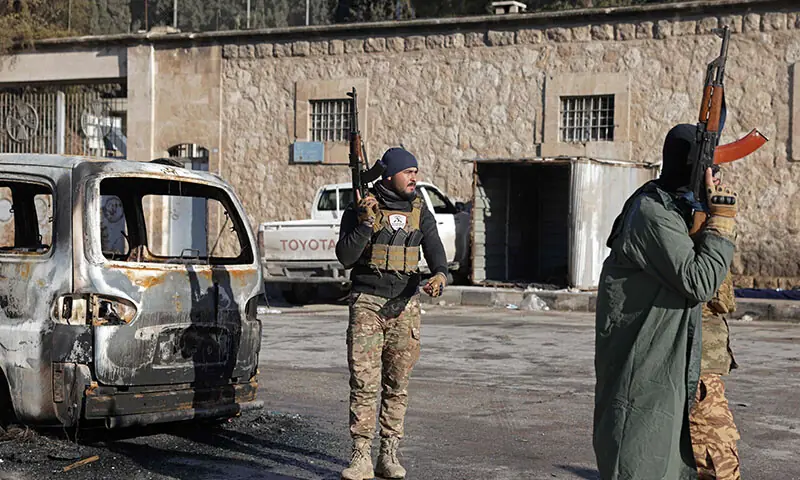
Turkey has launched successive offensives to push Kurdish forces from the frontier.
Elham Ahmad, a senior official in the Kurdish administration in Syria’s northeast, accused Syrian authorities of “choosing the path of war” by attacking Kurdish districts and of “seeking to put an end to the agreements that have been reached”.
“We are committed to them and we are seeking to implement them,” she told AFP.
The March integration agreement was meant to be implemented last year, but differences, including Kurdish demands for decentralised rule, have stymied progress.
Ahmad welcomed on X a proposal by international mediators to evacuate the Kurdish forces from Sheikh Maqsud, but on condition that the local Kurdish population is protected.
Nanar Hawach, senior Syria analyst at the International Crisis Group, said the renewed clashes cast doubt on the government’s ability to unite the country after years of civil war.
Syria’s authorities have committed to protecting minorities, but sectarian bloodshed rocked the Alawite and Druze communities last year.
ISLAMABAD: While chairing a meeting to review the performance of the Immigration Wing of the Federal Investigation Agency (FIA), Interior Minister Mohsin Naqvi on Friday issued orders for strict screening of travel documents at airports.
The ongoing campaign to prevent illegal immigration and human smuggling, as well as actions against the professional beggar mafia, came under detailed discussion during the meeting.
The interior minister’s order came amid complaints of arbitrary offloading at airports despite travelers carrying valid documents.
In the first week of December, Naqvi had said that 50–70 passengers were being offloaded daily from flights to protect the country’s passport reputation, which, at an average of 60 per day, comes to fewer than 22,000 in a year. However, official figures showed that the actual number of offloaded passengers in 2025 was three times higher, at 66,000.
During the meeting today, the interior minister ordered the continuation of relentless and strict action against the mafia involved in illegal immigration.
“Elements involved in human smuggling do not deserve any leniency,” he said, making it clear that no one would be allowed to tarnish Pakistan’s image.
He directed the FIA to effectively implement immigration laws and make the immigration checking system at airports more efficient.
Naqvi also directed an effective crackdown against the professional beggar mafia and their backers.
The meeting was attended by federal secretary interior, additional secretary interior, director general FIA, directors Karachi and Lahore Zones.
Amid fears that genuine travellers would be given a tough time at airports in the name of “strict screening,” an official said there were clear directions from the interior minister that no passenger with complete and valid travel documents should be stopped.
He added that strict screening, coupled with a crackdown against fraudulent visa agents exploiting citizens, was meant to curb attempts to use fake or unverified documents, since such practices damage Pakistan’s image abroad.
Following months of growing public fury and social media outrage, Prime Minister Shehbaz Sharif finally took notice of questionable offloading in mid-December and formed a “special committee” to look into the issue and ensure safe migration.
Disclosing this, Federal Minister for Overseas Pakistanis Chaudhry Salik Hussain said, “By the end of January, we will prepare proposals to address these issues,” stressing that safe migration is a “fundamental right.”
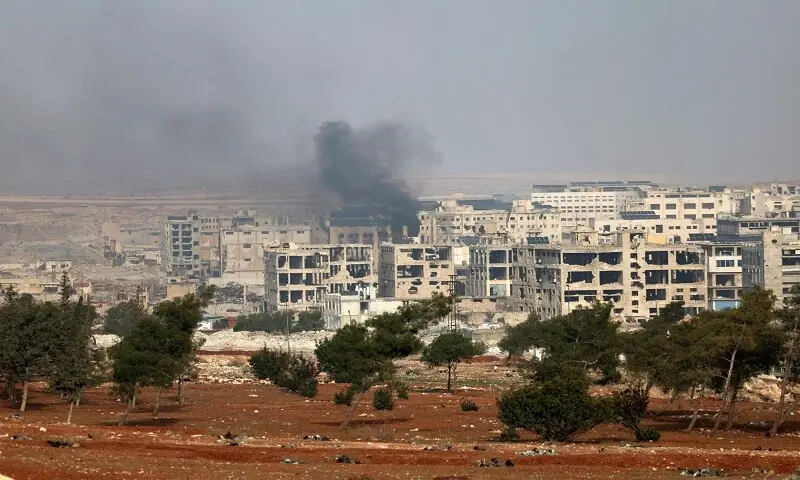
Fighting intensified on Thursday between Syrian government troops and Kurdish fighters in the northern city of Aleppo, with a fierce exchange of fire extending into the night and rescue workers scrambling to put out fires ignited by the shelling.
Plumes of smoke rose above the city skyline at dusk and the boom of artillery could be heard across Aleppo as the Kurdish fighters tried to repel the troops’ advance and cling to neighbourhoods under their control.
The fighting, which erupted on Tuesday, has driven more than 140,000 people from their homes and left at least seven civilians dead, according to Syrian authorities.
The deadly stand-off between Damascus and Kurdish authorities, who have resisted integrating into the central government, is a major challenge for Syrian President Ahmed al-Sharaa, who has pledged to unite the country after 14 years of civil war.
Syria’s army gave a window on Thursday for residents to evacuate the neighbourhoods held by Kurdish forces in Aleppo before launching new strikes there. It released more than seven maps identifying areas it said would be targeted and announced a curfew in the neighbourhoods of Sheikh Maqsoud and Ashrafieh from 1200 GMT.
The Kurdish forces, including the Syrian Democratic Forces (SDF) and the Asayish, or internal security forces, said they had pushed back Syrian troops’ attacks.
Syrian sources told Reuters the US was spearheading efforts to reach a ceasefire.
SDF head Mazloum Abdi said the government forces’ strikes and deployment of tanks had undermined “the chances of reaching understandings, create conditions for dangerous demographic changes, and expose civilians trapped in the two neighbourhoods to the risk of massacres”.
Two government officials told Reuters that negotiations were underway over the withdrawal of Kurdish forces from the city.
The Asayish, in a written statement, denied that its forces had requested safe passage and called instead on the Damascus government to withdraw its forces.
“The attacks carried out against civilians in Aleppo have unfortunately exacerbated concerns about the true intentions of the SDF and created a pessimistic picture regarding peace efforts,” Turkish Foreign Minister Hakan Fidan told a joint press conference with his Omani counterpart on Thursday.
“The SDF’s insistence on protecting what it has at all costs is the biggest obstacle to achieving peace and stability in Syria,” Fidan added.
Turkey views the US-backed SDF, which controls swathes of northeastern Syria, as a terrorist organisation and has warned of military action if the group does not honour the integration agreement.
The Kurdistan Regional Government’s Prime Minister Masrour Barzani said he was deeply concerned by attacks on Kurdish neighbourhoods in Aleppo, warning that targeting civilians and attempts to alter the area’s demography amounted to what he described as ethnic cleansing.
Barzani called on all sides to exercise restraint, protect civilians and pursue dialogue.
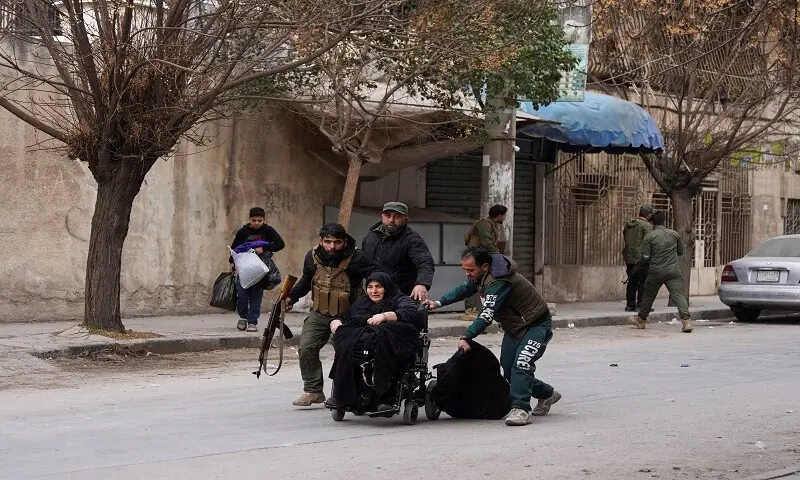
The SDF said Damascus’s evacuation warnings ahead of shelling could amount to forced displacement and war crimes under international humanitarian law.
Kurdish-led authorities established a semi-autonomous administration in northeast Syria and parts of Aleppo during Syria’s 14-year war and have resisted fully integrating into the new government that took power after former President Bashar al-Assad was ousted in late 2024.
Damascus reached a deal with the SDF last year that envisaged full integration by the end of 2025, but progress has been limited, with both sides accusing the other of stalling.
The US has sought to mediate, holding meetings as recently as Sunday, though those talks ended without tangible results.
Pakistan and Saudi Arabia are in talks to convert about $2 billion of Saudi loans into a JF-17 fighter jet deal, two Pakistani sources said, deepening military cooperation months after the two nations signed a mutual defence pact last year.
The talks underscore how the two allies are moving to operationalise defence cooperation at a time of acute financial strain and as Saudi Arabia is reshaping its security partnerships to hedge against uncertainty about US commitments in the Middle East.
The mutual defence deal was signed following Israel’s strikes on what it said were Hamas targets in Doha, an attack that shook the Gulf region.
One of the sources said the discussions were limited to the provision of JF-17 Thunder fighter jets, the light combat aircraft jointly developed by Pakistan and China and produced in Pakistan, while the second said the jets were the primary option among others under discussion.
The first source said the total deal was worth $4bn, with an additional $2bn to be spent on equipment over and above the loan conversion.
The sources close to the military with knowledge of the matter spoke on condition of anonymity because they were not authorised to speak on the deal.
Pakistan’s Air Chief Zaheer Ahmed Baber Sidhu was in Saudi Arabia for bilateral talks, including on “military cooperation between the two sides”, Saudi media outlet SaudiNews50 said on social media platform X on Monday.
Amir Masood, a retired air marshal and analyst, said Pakistan was in talks about or had finalised deals with six countries to provide equipment, including JF-17s and electronic and weapons systems for the jets.
He said those countries included Saudi Arabia, but could not confirm any details about the negotiations.
The JF-17’s marketability has been increased because “it is tested and has been used in combat,” he told Reuters, adding that it’s also cost-effective.
The aircraft was deployed during the conflict with India last May, the heaviest fighting between the neighbours in decades.
The military or finance and defence ministries did not immediately respond to Reuters’ requests for comment. Saudi Arabia’s government media office also did not respond.
The mutual defence pact, signed in September, committed both sides to treat any aggression against either country as an attack on both, significantly deepening a decades-old security partnership.
Pakistan has long provided military support to the kingdom, including training and advisory deployments, while Saudi Arabia has repeatedly stepped in to support Pakistan financially during periods of economic stress.
In 2018, Riyadh announced a $6bn support package for Pakistan, including a $3bn deposit at the central bank and $3bn worth of oil supplies on deferred payment.
Saudi Arabia has since rolled over deposits multiple times, including a $1.2bn deferment last year, helping Islamabad stabilise its foreign exchange reserves amid chronic balance-of-payments pressures.
Pakistan has in recent months stepped up defence outreach as it seeks to expand arms exports and monetise its domestic defence industry.
Last month, Islamabad struck a weapons deal worth more than $4bn with Libya’s eastern-based Libyan National Army, officials said, one of the country’s largest-ever arms sales, which includes JF-17 fighter jets and training aircraft.
Pakistan has also held talks with Bangladesh on the possible sale of JF-17s, as it widens its arms supply ambitions beyond South Asia and the Middle East.
On Tuesday, the defence minister said the success of its weapons industry could transform the country’s economic outlook.
“Our aircraft have been tested, and we are receiving so many orders that Pakistan may not need the International Monetary Fund in six months,” Khawaja Asif told Geo News.
Pakistan is currently under a $7bn IMF programme, its 24th, which followed a short-term $3bn deal that helped avert a sovereign default in 2023. It secured the Fund’s support after Saudi Arabia and other Gulf allies provided financial and deposit rollovers.

Pakistan Commissioner for Indus Waters Syed Muhammad Mehar Ali Shah on Sunday said India’s claim of placing the Indus Waters Treaty (IWT) in “abeyance” has no legal basis and that the treaty remains fully in force under international law.
In April 2025, India held the IWT in abeyance following the attack on tourists in occupied Kashmir’s Pahalgam that killed 26 — an incident New Delhi blamed on Islamabad without evidence. Pakistan termed any attempt to suspend its water share an “act of war”. In June, the Permanent Court of Arbitration held that India cannot unilaterally hold the treaty in abeyance.
Speaking on Geo News‘ programme ‘Jirga’, Shah talked about the legality of India holding the IWT in abeyance and said: “As far as holding the treaty in abeyance is concerned, the word ‘abeyance’ is not recognised under international treaty law. It is a coined term, because we believe India understands that it cannot suspend, breach or terminate the treaty.”
However, he cautioned that India’s continued non-cooperation within the rules-based framework, effectively sidestepping its obligations on self-created grounds, was “alarming” and prompted Pakistan to pursue a formal and carefully calibrated legal and diplomatic response.
“To address this, Pakistan is employing efforts carefully, and whatever steps are being taken are formal in nature,” he said.
He said the treaty was carefully negotiated to withstand political tensions and disputes, stressing that its dispute-resolution mechanism was designed to prevent unilateral actions.
About Indian Prime Minister Narendra Modi‘s threats of stopping the flow of Pakistan’s share of water, Shah asserted: “There is no room for stopping or partially stopping Pakistan’s water. This also goes against moral standards.
“Technically, if one party is stubborn on diverting the western rivers flowing into Pakistan, to reduce it to stop it, so naturally, there have been inter-basin transfer examples in the world,” he observed.
“When we gave the three eastern rivers to India, we have been facing consequences since the beginning of the treaty. Sutlej is always dry, barring the flooding season. Ravi is dry,” the water commissioner said.
Shah reiterated that any move by India to reduce water flows to Pakistan “would be considered an act of war”.
“There is no fixed amount of water allocated to Pakistan,” he said, adding that the waters should be available to Pakistan based on the “natural pattern of the western rivers”.
“So far, Chenab, Jhelum and Indus are receiving water in a natural pattern. But since April 24, 2025, India has created three such episodes, which we picked up — twice in May and once in December when they increased the flow, and then decreased the flow for a few days,” Shah pointed out.
Speaking about the procedures stated under the “well-thought-out” pact, Shah said one clause stated that in the face of conflict, Pakistan and India will peacefully solve the water matter. “Otherwise, they will hand it to a neutral party,” he added.
The official noted, “The 12th and last article of this treaty has four provisions. In the last paragraph, it says that with the passage of time, some changes can be made to the pact, but both parties have to mutually agree; otherwise, the pact will remain fully enforced.
“And it clearly says that no one party can unilaterally change it,” the water commissioner stressed.
Asked whether the IWT favoured India, Shah replied that the three eastern rivers — Beas, Ravi and Sutlej — have a “geographic advantage”, unlike the western rivers.
Recalling the history of water disputes between the two neighbours, Shah said India halted the rivers’ flow to Pakistan on March 31, 1948, which Pakistan protested on a bilateral level and took the issue to the United Nations.
After the IWT was agreed upon in 1960, India first violated the pact when it was building the Salal Dam, with which Pakistan had issues, and they were subsequently resolved through the treaty.
“The pact does not have a guarantor as such, but it has its own mechanism,” the official observed.
The water commissioner said the basic feature of the IWT was that the western rivers’ natural flow must not be altered.
“India was allowed to use the western rivers for hydroelectric power generation only in line with the pact guidelines. If there is a violation, then any party can take the matter to a third forum,” Shah said.
Providing an example of such an instance, Shah recalled that Pakistan decided to take the matter to a third forum when India built the Baglihar Dam on the western rivers, “violating five of the conditions”.
The official noted there were two third-party forums where conflicts could be taken — “one is a neutral forum, and the other is the Court of Arbitration forum”. The procedure for it, Shah added, was that the water commissioners must inform each other and suggest whether the matter should go to a neutral party or a court.
“So if one party does not agree to going to the court, for instance, then the matter must go to a neutral party, who will decide whether the matter falls within their expertise,” he explained, adding that internationally recognised experts are part of the team when the issue is taken to a neutral forum.
“When the Baglihar Dam decision was taken, it was not in favour of Pakistan. The extent of that decision was only confined to the Baglihar Dam and it did not apply to any future development plans,” Shah said.
The water commissioner highlighted that although Pakistan did not agree with the decision, it was binding under the IWT.
“So in order to stop India from taking future decisions based on the decision of the Baglihar Dam, Pakistan filed a case at the Court of Arbitration for a general interpretation.”
Detailing more water conflicts, Shah said that after Baglihar, Pakistan raised the issue about India constructing the 850 megawatt Ratle Hydroelectric Plant on the Chenab river bilaterally first, and also went to a third forum.
The water commissioner then mentioned that Pakistan had also raised objections on the Kiru and Kwar hydroelectric projects in India, whose designs New Delhi shared with Islamabad prior to the April 2025 developments.
At 4:21 on Saturday morning, President Donald Trump sent a message on his Truth Social platform: the United States had carried out a daring mission to capture Venezuelan President Nicolas Maduro and his wife.
The action came as a surprise, but according to sources familiar with the matter, planning for one of the most complex US operations in recent memory had been in the works for months and included detailed rehearsals.
Elite US troops, including the Army’s Delta Force, created an exact replica of Maduro’s safe house and practiced how they would enter the strongly fortified residence.
The CIA had a small team on the ground starting in August who were able to provide insight into Maduro’s pattern of life that made grabbing him seamless, according to one source familiar with the matter.
Two other sources told Reuters the intelligence agency also had an asset close to Maduro who would monitor his movements and was poised to pinpoint his exact location as the operation unfolded.
With the pieces in place, Trump approved the operation four days ago, but military and intelligence planners suggested he wait for better weather and less cloud cover.
At 10:46pm EST on Friday, Trump gave the final go ahead for what would be known as Operation Absolute Resolve, Chairman of the Joint Chiefs of Staff General Dan Caine told reporters.
Trump, surrounded by his advisers at his Mar-a-Lago club in Palm Beach, Florida, watched a live stream of the events.
How the hours-long operation unfolded is based on interviews with four sources familiar with the matter and details Trump himself has revealed.
“I’ve done some pretty good ones, but I’ve never seen anything like this,” Trump said on Fox News just hours after the mission was completed.
The Pentagon has overseen a massive military buildup of forces in the Caribbean, sending an aircraft carrier, 11 warships and more than a dozen F-35 aircraft.
In total, more than 15,000 troops have poured into the region for what US officials have long described as anti-drug operations.
According to one of the sources, Trump senior aide Stephen Miller, Secretary of State Marco Rubio, Defense Secretary Pete Hegseth and CIA Director John Ratcliffe formed a core team working on the issue for months with regular - sometimes daily - meetings and phone calls. They often also met with the president.
Late on Friday night and into early Saturday, Trump and his advisers huddled as a number of US aircraft took off and carried out strikes against targets inside and close to Caracas, including air defense systems, according to a US military official.
Caine said the operation involved more than 150 aircraft launched from 20 bases around the Western Hemisphere, including F-35 and F-22 jets, and B-1 bombers.
“We had a fighter jet for every possible situation,” Trump told Fox News Channel’s “Fox & Friends.”
Sources have told Reuters the Pentagon had also quietly moved into the region refueling air tankers, drones and aircraft specialising in electronic jamming.
US officials said the airstrikes hit military targets. Images taken by Reuters at the La Carlota air base in Caracas showed charred military vehicles from a Venezuelan anti-aircraft unit.
With the strikes taking place, US Special Forces made their way into Caracas heavily armed, including with a blowtorch in case they had to cut through steel doors at Maduro’s location.
Around 1 a.m. EST Saturday, Caine said, the troops arrived at Maduro’s compound in downtown Caracas while being fired upon. One of the helicopters was hit, but still able to fly.
Social media videos posted by residents showed a convoy of helicopters flying over the city at low altitude.
Once they reached Maduro’s safe house the troops, along with FBI agents, made their way into the residence, which Trump described as a “very highly guarded … fortress.”
“They just broke in, and they broke into places that were not really able to be broke into, you know, steel doors that were put there for just this reason,” Trump said.
“They got taken out in a matter of seconds.”
Once the troops were inside the safe house, Caine said, Maduro and his wife surrendered. Trump said the Venezuelan leader had tried to reach a safe room but was unable to close the door.
“He got bum rushed so fast that he didn’t get into that,” Trump said.
Some US forces were hit, Trump said, but none were killed.
As the operation unfolded, Rubio started to inform lawmakers that it was underway. The notifications only began after the operation started and not before, as is customary for key lawmakers who play an oversight role, officials told Reuters.
As the troops left Venezuelan territory, Caine said, they were involved in “multiple self defense engagements.”
By 3:20am EST, the helicopters were over water, with Maduro and his wife on board.
Almost exactly seven hours after Trump announced the operation on Truth Social, he made another post.
This time it was a photograph of the captured Venezuelan leader blindfolded, handcuffed and wearing grey sweatpants.
“Nicolas Maduro on board the USS Iwo Jima,” Trump wrote, referring to the amphibious assault ship.
LAHORE: Gunmen on Friday attacked the convoy of Jhang Chamber of Commerce and Industry President Sheikh Fawad Akram — the brother of PTI Information Secretary Sheikh Waqas Akram — leaving one of his guards dead and three others injured near Jhang’s General Bus Stand (GBS), said police.
Reports said the incident took place near a petrol pump near GBS, as Fawad was headed to his office.
The four security guards who were injured in the attack were rushed to DHQ Hospital. However, hospital authorities referred a critically injured guard to Faisalabad, but he succumbed to his injuries.
Jhang police, meanwhile, arrested four suspects, including two alleged gunmen and Fawad’s stepbrother, a statement from a police spokesperson read.
Police said that Fawad and his stepbrother were travelling in separate convoys when their vehicles collided with each other. The collision triggered a scuffle between guards from both groups.
The gunmen of another suspect, who was travelling with the stepbrother, allegedly opened fire on Fawad’s group, shooting four of his guards, the statement added.
Quoting Jhang District Police Officer Bilal Iftikhar Kayani, the statement read that strict action is being taken against the suspects and that “no concession would be made to those who challenge the law”.
“Turning a minor dispute into violence and firing is a threat to the peace of the society,” DPO Kayani was quoted as saying.
Recounting the incident on camera, Fawad said that he and his guards were unarmed at the time, as they were not allowed to carry weapons.
Meanwhile, Waqas issued a statement on his X account condemning the incident as a “cowardly and planned attack”.
“It is extremely alarming that a peaceful city, which had become a cradle of peace due to our collective efforts over the past several years, is today being dragged back into unrest due to a few miscreants and rogue elements,” Waqas wrote.
“I make an unequivocal demand from the Punjab Police that all suspects involved in the incident be arrested immediately, transparent and impartial investigations be ensured, and those responsible be given exemplary punishment in accordance with the law,” he added.
In a later statement, Waqas said that the deceased guard’s family blocked Gujranwala Road and placed his body in front of Jhang Civil Hospital.
“We stand with his family and will fully support him,” the PTI information secretary wrote. “We will never leave them alone—we will ensure Mohsin’s family gets justice and will knock on every door of justice.”
Reports said that over the past six months, Fawad’s stepbrother had joined hands with the Grand Democratic Alliance (GDA) to contest elections against Waqas and his father, provincial lawmaker Sheikh Muhammad Akram.
The GDA had also recently announced they would contest all future elections against the Sheikh family.
